Showing posts with label VW Museum. Show all posts

Wednesday, February 20, 2008

Funkengroovin Wednesday - Scenes From A Museum, Miscellaneous

Reders will be relieved to know that this is the last in VB's series of posts about the VW Museum in Wolfsburg, Germany. VB's "Miscellaneous" includes a few cars, and exhibits that just did not fit in with the previous posts.


Previous Museum Related Posts:


(Below) Experimental VW.
Forschung means research.


(Below) Type 3 aka Fastback:

From Wiki: "The Type 3 was introduced to diversify Volkswagen's product range beyond the Type 1 (Beetle), the Karmann Ghia, and the Type 2 (Bus). The Type 3 was designed to allow Volkswagen to make a more sophisticated car while maintaining much of the engineering from the Type 1. Though available to much of the world, the Type 3 line was not exported to the United States through Volkswagen of America until the 1966 model year, when the Squareback and Fastback were added to their line-up."

This is when Volkswagen's innovation started going straight down the tubes. VB doesn't like it! She says it's beginning of VW's fugly / boring car syndrome, (except for the Cabriolet.)


(Below) VW Golf:
"The Volkswagen Golf or VW Golf (Mark 1 and Mark 5 badged as Volkswagen Rabbit in the United States and Canada, Mark 1 badged as Volkswagen Caribe in Mexico) is a compact car / small family car that Volkswagen manufactures. The front-wheel drive Golf was Volkswagen's first successful replacement for the air-cooled Volkswagen Beetle. Historically, it is Volkswagen's best-selling model and the world's third best-selling model, with more than 25 million built by 2007."
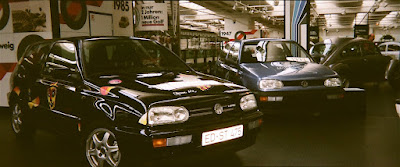


(Below) The body of a Golf, with all the parts laid out on a table.


(Below) Golf engine parts.


NEWS:

VW Bug owners have a blast at event

"Volksblast 2008, a classic Volkswagen car show, returned to South Miami on Sunday. Vintage Bug owners came from across the country to show off their vehicles." (Further information and photo at the link.)


Ahh, the Porsche/Piech/VW Takeover saga continues!
VW's Piech still trying to maintain iron grip, may oust Porsche boss


Volkswagen Baja Bug featured by Jalopnik. As usual many nice photos with details.


Who built the electric car?

"Garver, however, was not inspired by the 2006 film to build his own electric car. He built his electric way back in 1980 from a 1971 Volkswagen Super Beetle.

"It started like twenty years ago, in 1981 or '82. I got interested in it [building an electric car] and I found some articles where people had converted a Volkswagen out in California to electric power," Garver said.

"They were using old aircraft engines. So I thought 'this might be kind of fun to do.' And seeing as I work as a research scientist and all, I built a car with an aircraft engine in the '80s and ran it to the University a little bit then," he said." (More on Garver's car and a photo at the link.)


Eight 'Beetle guys' keep original Bug alive

"VW Germany stopped production of the Beetle in 1978 but Puebla making them, mostly for the local and Latin American market, where they were hugely popular. The last of more than 21-million Beetles was built there in 2003.

Mexicans fondly refer to it as "Vochito" - little beetle - and it continues to be the classic, indestructible Mexican taxi

But its days are numbered; cheap vehicles from China and India are entering the market, others from Japan and South Korea have been there a while.

Many Mexicans are unhappy about that; taxi drivers from Taxco, a high-altitude mining town with steep streets in the state of Guerrero have asked VW to at least continue to build Beetle engines. They claim no other vehicle suits the tough conditions there and there many enthusiasts who look after their Beetles like precious jewels."

Auto owners bare all in racy survey

"Last year, 1,000 men and women commissioned by Lifeskool, an on-demand cable show, took part in a "Cars and Summer Romance" survey. Nearly 70% said they wanted to have sex in their vehicle, and nearly half the respondents have been using their cars as a nookie nest since graduating high school.

In 2006, Britain's Daily Mail reported that 4,000 people said their top fave car to have sex in was the Volvo Estate (that's the V50 wagon here in the U.S.).

It's a surprising result given Volvo's overall non-glam reputation in America.
The Mercedes Sprinter — an upscale van — came in second, and the VW Camper van came in third. BMW's 3-series was fourth, and, believe or not, the Ford Escort was number five.

Sixty-eight percent of the respondees said they'd had sex in a car, but the most alarming news was that one out of 10 said they'd engaged in amorous activities while the car was moving.

A further 6% admitted to damaging their cars during the encounters."


And last, but not least a big "No Duh" for the linked article below. Oh, and BTW, go and express your opinion. This is it for this week's Rotten News. There's more on the web, but VB has her limitis!
Will VW loyalists turn their back on the Routan?

"...And if the buzz on the web -- including the comments on this blog post from About.com's Minivans site -- are any indication, the Volkswagenisti may be none to happy about the fact that the newest Volkswagen isn't a Volkswagen, but is in fact a Chysler."

WTF is a "Volkswagenisti"? That sounds awfully Italian! When VB tried to do a Goggle search for it, all she got was a bunch of Italian sites. Aand, then when she tried to get a definition, the closest thing Goggle could find was this:
"In the late 1990s, a group of Volkswagen enthusiasts formed Volkswagenism, a satirical religion based off of owners devoted loyalty to the Beetle, and the company. Under the leadership of founder Jason Gaudet, this "religion" has gained notoriety through radio, television and print coverage from around the world...turning ordinary fans of the car into Volkswagenists."


Bon Jovi - It's My Life (Two VW Beetles in this video.)


Sunday, February 17, 2008

Funkengroovin Wednesday - Scenes From A Museum, The Toys

A very short blog today, as VB tries to finish up with her Museum series. She plans to close up with one last post about miscellaneous VW items. For now, if you'd like to visit the museum, but were worried about taking the kids, have no fear. Here are a few things for the kids to see and do, while at the VW Museum in Wolfsburg, in addition, of course, to going gaga over some of the vehicles on display. Again, apologies for the grainy photos, and for the fact that VB knows it's not Wednesday. (Also, Google spellcheck still not working, but Cairo Internet is much better.)

Previous Museum Related Posts:
Funkengroovin Wednesday-Scenes From A Museum
Funkengroovin Wednesday - Scenes From A Museum, Beetles
Funkengroovin Wednesday-Scenes From A Museum, The Oddities and Egyptian Relatives
Funkengroovin Wenesday-Scenes From A Museum, Rarities and Relatives


(Below) The perennially annoying rocking ride, seen outside many American grocery stores (except not usually in the form of a Beetle.)


(Below) Two LEGO Cars.


(Below) One of my favorite pins - a sample of what you can find at the"Museum Shop". The VW Museum Shop, was, as of 1996, a wall display at the exit door of the Museum. Not at all like the museum shops you find in artsy museums these days. It was rather stark and you could easily walk right past it, on your way out the door. There was a service counter, and opposite, items were displayed on a wall. That was about it. Umbrellas, ties, keychains, jewelry, and an odd assortment of items were available, at that time. VB's not sure what the "Museum Shop" looks like or what they carry these days, although here's a link, if you'd like to browse (German only.)


Wednesday, February 13, 2008

Funkengroovin Wednesday - Scenes From A Museum, Rarities and Relatives

Since the last post was The Oddities and Egyptian Relatives, here's a selection of cars from the Museum that are related to the Beetle and to each other, as well (very strange, and extended arrangements that VW has had with other auto makers) aka "The Relatives."

Please let VB know if you find any errors (not including spelling as spell checker is still out of order.)

Previous Posts:

Funkengroovin Wednesday - Scenes From A Museum
Funkengroovin Wednesday - Scenes From A Museum, Beetles
Funkengroovin Wednesday - Scenes From A Museum, The Oddities and Egyptian Relatives


(Below Two Photos): Horch From Wiki: "The company was established by August Horch, a former production manager for Karl Benz, and a partner on November 14, 1899 with a capital of 30,000 Goldmark at Ehrenfeld, near Cologne. Horch was also later the founder of the German automaker, Audi, which is named after the Latin translation of his surname (Latin word for the regional Saxon expression, horch, which is the imperative form of “hark” - "listen" in German)."


(Below): NSU Type 32 From Wheelspin: The History Of The Beetle-The Earliest Beginnings Pt.1
"With the hard-won experience of the Type 12 project, Porsche was soon able to build the
Type 32, a fully functional prototype that avoided many of the mechanical problems of the earlier car. The NSU car retained the same layout as its Zundapp predecessor, but in place of the radial five-cylinder engine was a horizontally opposed four cylinder 1 litre unit. Unfortunately for Porsche, contractual agreements with Fiat forced NSU out of the carmaking business, leaving Porsche only the prototype to show for its efforts."


(Below): Hebmuller From Volkswagens Of The World:
"Type 14A Hebmuller Cabriolet ...Volkswagen managing director, Heinz nordhoff, chose Hebmuller and Karmann to make cabriolets based on the Beetle. Karmann was asked to produce a four-seater convertible and Hebmuller a two-seat roadster. To own one would elevate you to a very special level of VW enthusiast. And, to buy even a rusty relic today would cost a veritable heap of money."

More about the Hebmuller, with loads of photos available at Wheelspin's, Weird & Wonderful VWs: The Hebmuller Story


(Below L-R): Porsche 914,Type 3 Karmann, Karmann Ghia

From Volkswagens Of The World
:
Porsche "For the 1976 model year only, Porsche produced a version of the 911 with a 2.0 litre Type 4 Volkswagen engine. It was called the Porsche 912E and sold only in the US market for a year. It was a stop-gap car produced to fill a niche in the market for a four-cylinder Porsche that was cheaper than the six-cylinder 911. 1975 was the last year of the VW-Porsche 914 (also with a 2.0 litre Type 4 engine) and the front-engined, water-cooled, four-cylinder Porsche 924 was not ready for release in the US market until the 1977 model year. (The VW-Porsche 914 was sold in the USA as a 'Porsche 914' and through Porsche rather than VW dealers.)"

From Volkswagens Of The World:
Type 34 1500 and 1600 Karmann Ghia "In September 1961 Karmann introduced its version of the Volkswagen Type 3, known as the VW Karmann Ghia 1500 Coupe'...It has an unusual body style that people either love or hate. It was built in the Karmann factory at Osnabruck on the VW Type 3 floorplan, engine, gearbox and running gear...The Type 34 Karmann Ghia was never sold as a convertible and production reached only 42,562 by July 1969...Regrettably, the Type 34 Karmann Ghia has the distinction of being the first model that Volkswagen ever deleted from its range. It's production line was given over to the VW-Porsche 914 sportscar."

And for the
Karmann Ghia (again from Volkswagens Of The World): "In September 1957 the VW Type 1 Karmann Ghia Cabriolet was introduced with a body just as pretty as that of the fixed-roof coupe'. Type 1 Karmann Ghias always had the same specification as the top-of-the-range and most powerful Beetles, except that the McPherson strut was never introduced Karmann Ghias. Production was from 1955 to March 1974. Like the Beetle Cabriolet, production of the Type 1 Karmann Ghia could have gone on for longer. However, its production line was needed to make the new front-wheel drive Volkswagen Scirocco sports coupe'."


NEWS:
More of the Rotten:

From Microbus to Routan: Will new VW minivan sell?

Where is the VW Microbus?

"But here we are at the 2008 Chicago show with a Dodge Grand Caravan given “Das auto” treatment. Sorry, this one is not straight out of Wolfsburg.

I knew it was rude, but I couldn’t help it. At the press conference, I stared at the abundant front overhang on the latest VW model to bear an unpronounceable name. It… is… huge. The Routan is no Microbus. (Perhaps it should be dubbed the “Rhinoplasty.”)

What happened? Business realities came crashing in. Engineering a Microbus that could meet increasingly stringent safety regulations in the States and abroad was adding significant cost, according to Volkswagen, and thereby reducing its market and profit potential.

The short-term fix in the United States was to partner with Chrysler, a relationship not unlike those VW had struck with other automakers in Europe through the years."


VW Taps Chrysler Design, Not Hippie Bus, for First American Van: Live at the 2008 Chicago Auto Show
"If you’ve been dreaming of some hip, new-wave version of the hippie microbus, dream on."


Not So Rotten News:

The self-parking van is just around the corner.

"Volkswagen has confirmed it is developing its car-based park assist system for commercial vehicle use.

It is looking at the system being launched this week on the VW Tiguan, after it was pioneered on the Touran, for the next generation Caddy and Crafter vans.

The park assist uses sensors, cameras and computer-links to the electronically assisted steering system to parallel reverse the vehicle into a parking space on either side of the road.

The driver simply switches on park assist when approaching a line of parked vehicles with suitable gaps and the electronics measure gaps, alerting the driver if there is one large enough for the vehicle.

Once a suitable gap is found the driver simply takes hands of the wheel and lets park assist take over turning the wheel as necessary to slip into the gap. Only the speed of the reverse and any forward correction is controlled by the driver."


(Go to the link for all the amazing photos and an in-depth description.)
VW Space Up! Blue: the one concept car I really, really want

"The SUB is concept and we may or may not see this get produced. I, for one, hope it does go into production because it’s frickin’ sweet. I always wanted one of the old VW buses and this is just ten times better.
I just hope VW puts this bad boy into production."

More photos here and here, both from autoblog.

From Jalopnik: Porsche Powered VW Transporter


HAPPY VALENTINE'S DAY TO ALL!

B-52s - Love Shack


Monday, February 11, 2008

Funkengroovin Wednesday - Scenes From A Museum, The Oddities and Egyptian Relatives

Trying to make up for lost posts during VB's return trip to Egypt and then the sudden Internet outage, VB presents another edition of Scenes from a Museum. And, yes, she knows it's not Wednesday anymore.

Previous Posts:
Scenes From A Museum, included Transporters
Scenes From A Museum, Beetles, had all Beetle photos.

All pics are digitized versions of photos taken during our trip to Germany, 1996, when we visited the Wolfsburg VW Museum.

(Below)VW Invader GT (?)


(Below) DKW, Baby Thunderbird:
"DKW cars in the 1950s were all based on characteristic 2-stroke engines which were gradually becoming obsolete and an aerodynamic body shell developed just before the War. Marketing these cars became more and more difficult and DKW desperately needed an image boost.
And so director William Werner, of US American origins, ordered his stylists one day in 1956 to design "a sportscar that has to look like a bomb". The stylists decided to check out what was on the market and ultimately came up with the 1000Sp; a German interpretation of the 1957 Ford Thunderbird with a non-removable coupe top not unlike that of the one-off 1956 Ford Thunderbird "Five-Window Hardtop" prototype." (Read and see much more about it on the link and here at Wiki.)

1965
"Daimler-Benz sold their shares in Auto-Union to VolksWagen Werke, who thereby got influence in Auto union. In 1965 DKW and AU 100 were removed from the manufacturing and a new Audi was introduced."


(Below L) Off White Car, NSU
(Below R) Predecessor to possibly the Wanderer W25 (VB's thinking this car is related to the Auto-Union line, but she's not exactly sure where. It took her several days of studious undertaking to come to this inconclusive guess.)

From Wiki: "The trademark of Auto Union was a symbol of four overlapping rings, symbolizing the four member companies (all four in a line, in an attempt to avoid confusion with the 5 Olympic rings). The trademarks and company names of the member companies - Horch, Audi, DKW and Wanderer - were continued; the four ring logo was used only in racing. The four ring logo of Auto Union is still a trademark, and now used by Audi."

Talking about strange relationships, especially since VB is in Egypt:
"In 1969, just as the car was about to be launched, NSU was taken over by Volkswagen, who integrated the Neckarsulm company with Auto-Union/Audi, which it had acquired in 1964." (Wiki)

From Marc's NSU Pages,
NSU Ramses: (Check out more of the description, and pics at the link.)

"The NSU Ramses Utilica was the first car produced in Egypt, and was the result of a coorporation between the new egyptian car firm Egyptian Automotive Co., and the german NSU. The factory was located right next to the Great Pyramids. Plans were to produce around 10.000 cars a year, most of the work being manual labor.

Other models created by were the Ramses Limousine, and Ramses Gamila, a two-seater sport car with a vignale body."

The Independent ranks The Ramses as one of the, Top Ten African Cars, "Based first on the British Frisky and then the NSU Prinz. As the name suggests, made in Egypt. One of Colonel Nasser's pet projects in the 1950s."


Further on down the genealogical automobile road:

"Nasr, (Arabic: النصر‎, long form: El Nasr Automotive Manufacturing Company) is Egypt's state owned automobile company, founded in 1960 in Helwan, Egypt. Since 1979 the company has produced licensed versions of the Fiat 128 and 125, and in 1991 introduced a further range of Fiat designed cars licensed via the Turkish company Tofaş. In the early 2000s Nasr began producing the Florida range under license from Serbian manufacturer Zastava.

Nasr was a replacement for the short-lived Ramses automobile (also state produced), which suffered from poor design and performance. The Nasr was intended to be an affordable car for the average person of means (though it was still too expensive for a large proportion of the Egyptian population). The company's creation was also part of the general industrialization process initiated after the Egyptian Revolution of 1952, which would see millions of Egyptians flock to urban areas to gain work in newly built factories and industrial centers."

VB wonders if any of those NSU Ramses,the Ramses Limousine, and/or Ramses Gamila are still around. That would be interesting - possibly another post too. For now - back to the Museum.

(Below): The Beetle Trolley Car


(Below): Experimental - ARVW: Much better photo at Wiki.

Also, here:
"The ARVW (Aerodynamic Research Volkswagen) set two world records, and seven class records, for diesel vehicles at the high-speed track in Nardo, Italy. The fastest lap was completed at a speed of 362.07 km/h. This experiment was designed to provide detailed information on the effects of aerodynamics on fuel consumption at high speeds. The drag coefficient of the ARVW, the "Silver Cigar," is 0.15. The test concluded that the vehicle consumed 6 liters per 100 km, at 250 km/h, and at top speed, 13.61 liters per 100 km. In comparison, renowned sports cars required 38 liters of fuel for 100 km."


(Below): Stretch Beetle Convertible


No music video today. Music videos offered only on real Funkengroovin Wednesdays. BTW, spellcheck is still not working, and the Internet is still fairly slow - no fun watching videos when it takes over an hour to load them. (VB hasn't really tried lately, since it has turned into a frustrating ordeal.)


Saturday, February 9, 2008

Funkengroovin Wednesday - Scenes From A Museum, Beetles

More pics from the Wolfsburg Museum. Today is Beetle Day. Go here for the first post, which includes Transporters. Again, photos are old SLR negatives that have been scanned onto a CD. The color is off (VB has tried to "pump it up" some) and they're grainy, too. VB only has iPhoto for touch-ups. More of these to come including: Oddities, Rarities and Relatives, Miscellanea, and Toys. (Also, If VB has been misspelling words, that's because the Google spellcheck is not working - and she's a really bad speller to begin with.)


Wrought Iron Beetle:


A Variety Of Beetles:


From Another Angle:


Custom Beetle:


Custom Beetle, Again:


Beetle Cross Section:

Wednesday, February 6, 2008

Funkengroovin Wednesday - Scenes From A Museum

In 1996 VB and family made a genealogical trip to Germany, where The Boss Man's family originates. Home base - Bramsche. Just south in Osnabruck, is a VW Factory that conducts tours. They were closed. After visiting the one remaining human from The WWII Russian Front, numerous cemeteries, sites, and pubs, we drove on to Wolfsburg. Below are Scenes from A Museum, which VB has digitized from SLR film. More to come, later, but for now enjoy. VB had to pump up the color as the photos turned out rather dull and very grainy.


(Below Center) Type 166 Schwimmwagen: See also, Wiki.

*"Perhaps the most technically advanced Volkswagen made during World War II was the Schwimmwagen, or swim car. It was designed by Ferdinanad Porsche and even by today's standards, is amazing. It is probably the only truly amphibious car ever put into scale production...It could be driven straight from the road into a river or lake without stopping and vice-versa." "Steering in the water was not by way of a tiller and rudder as with boats, but simply by changing the direction of the front wheels: the car was steered in the water just as it was on land - by the steering wheel."


(Below L) The Thing:

*"The Volkswagen 181 was sold under various names such as 'Safari,' 'Kurierwagen', 'Trekker', 'Merzweckwagen', 'Mehrzweckfahrzeug', and 'The Thing' (in the USA)."


(Below R) Type 147 Fridolin:

*"...which roughly translates into 'tiny toddler', a sort of pen name given to very little boys...As second-hand ex-government surplus vehicles, Fridolins became popular with young people in Europe because they were like small versions of Type 2 Kombis."


(*All quotes from Volkswagens of the World, by Simon Glen.)


(Below) A Trio of Transporters:


(Below) A Trio Of Transporter Varieties - from Behind:


(Below) More Transporters:


NEWS:

We've spotted one of these here in Maadi. Many photos available at the link, below.

Spirit of the VW Camper van goes Element-al

"The family vacation just hasn't been the same since the ubiquity of the Westfalia Camper and the VW Type2 as a family vehicle, both of which have been toppled by the rise of the minivan. There have been Westys since VW went mostly conventional with the Eurovan, but they're not much of a common sight on US Highways anymore.

Ursa Minor Vehicles understands that all those former kids who took trips to the Grand Canyon in a Westfalia have a soft spot for the poptop. Thus, the Ursa Minor ECamper kit for the Honda Element has been born."


Car Clinic

"Q I want to buy a motorhome with a bit of character. I’m considering a VW camper but wondered if there were any other funky models. All the new ones seem to be grey and functional. I saw what I think was a Mercedes camper van about 15 years ago, which was quite cool, but I’ve no idea what it was. Any suggestions? – RS from London

A The VW camper has achieved cult status, particularly among surfers, and secondhand examples are highly sought after. The earliest model, referred to as the split-screen model (or “splitty”), was built from 1950 to 1967.

Its successor was known as the “bay” or “breadloaf” (because of its shape) and was built from 1968 until the late 1970s. Prices for both range from £4,000 to as much as £15,000 for an exceptional example. The later, flat-screen models, are less sought after and go for £2,500-£6,000. See the VW camper owners’ club (www.vwcampers.com ) and for used examples go to www.dubfinder.com."


How Jack Johnson went from surfer to superstar

"The genesis of What You Thought You Need was the four months Johnson and his wife, Kim, spent touring Europe in a VW camper van after they graduated from college. Losing Keys, his most overtly political song, was inspired when he noticed two bumper stickers on the car ahead. “One was Support Our Troops, the other was Jesus Loves You. I thought, what would Jesus think if he saw that?”


VW launches Caddy Maxi van


Courtesy of CarDomain Car Blog (More information and photo of the concept car at the link below):

VW Helps Make Minivans Almost Cool

"Though piggybacking its new minivan on Chrysler's Town & Country platform, VW promises a van that'll have a character all its own. The new van, dubbed the Routan—sharing the "-an" suffix with VW's other minivans, Touran and Sharan—will be unveilled next month at the Chicago Auto show."

VW Routan: Missing the minivan crest?


Something Rotten? Businessweek critique about VW's U.S.A. business practices.
VW's Sales Target: Bold or Bull?

I’m not as down on the Routan name for the Volkswagen van as Welch is. Volkswagen has a history of naming problems…God knows…but this isn’t the most egregious example. I nominate the Touareg for that designation. Although, the Bora, which is the European Jetta, comes close.


Key to the Highway - Eric Clapton


(Internet here in Cairo is working better, but still incredibly slow.)