Showing posts with label The Stupid Well. Show all posts

Wednesday, July 2, 2008

Funkengroovin Wednesday - Frankfurt Airport and Beyond

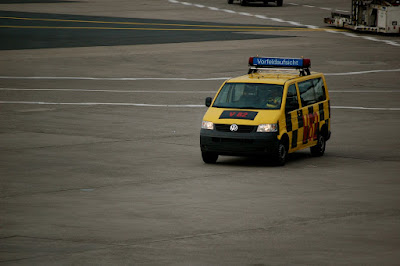
How many times has VB passed through Frankfurt Airport watching all the hard working VWs, while sipping her hot latte? Too many. So this time, VB decided to do something about it. But first, she needs to point out the car below, on display at the Duty Free. The Boss Man wants this Mercedes (Mechatronik), and he wouldn't mind the blond sitting next to him, as well.

BTW, every time VB passes through the Frankfurt Airport, they seem to change everything around. It's gotten to be absolutely confusing anywhere outside the Gate B area.


(Below):
The workhorse of the VW fleet at the Frankfurt Airport, appears to be the T5 aka Eurovan. From Wikipedia: "The fifth generation of the VW Transporter hit the market in Europe late in 2003. It is a direct successor to the T4 in its looks and utility value, unlike the Microbus concept car that VW had been showing around several years prior to the T5's introduction. The Microbus concept was almost produced, but Volkswagen scuttled plans for building it due to cost problems.
The T5 Transporter is not available in the North America in any form. Instead, Volkswagen offers the Volkswagen Routan, a passenger minivan based on Chrysler LLC's Dodge Caravan."


(Below) A VW T5 truck.


The following photos were taken on the way home from The Cairo Airport.
(Below): A VW Bus passing a ginormous truck.


(Below): More of the "Riding On Top" phenomenon.


(Below): Passing a Beetle.


NEWS:
Photos of new VW ads from Brazil: "VOLKSWAGEN TRUCKS. FOR EVERY KIND OF LOAD."
(These are probably going over much better than the new Walmart milk cartons.)

A commentary from the New York Times: Be the Prius
"Motorists can drive smarter in response to high fuel prices." And also, from the same author, Don't Drive Less. Drive Smarter:
"Studies have shown significant increases in fuel economy are achievable simply by changes in driving style (a few things got cut from this piece, by the way, including an obvious one: Cruise control aids MPG — but not cruise control at 70 mph)."

Any NASCAR fans out there? Then Ask A NASCAR Driver, should be for you - again, from the New York Times, Freakonomics Blog. Go ahead, ask Kyle Busch anything you want.

Drive-ins: An American Classic Reborn
"...About 400 drive-ins presently operate in the United States, a surprisingly large number in this age of personalized, on-the-go media, but many people don't even know they exist. Today, the industry is just a glimmer of what it was once. Back in the 1950s, at the height of the drive-in era, there were 4,000 theaters showing first-run films — it was a marriage of two great American passions: automobiles and movies..."There's nothing quite like [the drive-in]," says April Wright, a filmmaker who has traveled the U.S. for her upcoming documentary, Going Attractions: The Rise and Fall of the Drive-In as an American Icon."

Prince Charles' Aston Martin Hybrid Runs On Wine
(Hiccup!)

Auto biography:'76 VW Beetle convertible is Newport couple's pride and joy
(That's Newport, Rhode Island, BTW.)

"NEWPORT It was a case of falling in love in paradise.

When Jo-Ann and Kevin Burns visited Lahaina on Maui, Hawaii, in 1978, she fell in love with the ubiquitous Volkswagen Beetle convertibles that were being used for basic transportation."

Automotive profile: Volkswagen's Heinz Nordhoff
"While working at Opel, he was noticed by Major Ivan Hirst and Colonel Radclyffe of the British Occupational Force that was running Volkswagen after the Second World War.

The pair needed someone to organize the reconstruction of the VW factories that had been ruined during the war.

Appointed VW's managing director on the first day of 1948, Nordhoff flourished because he realized the potential of one little car."

Hot Wheels of fortune
"After 40 years and 4 billion sales, Hot Wheels colectors know it's the little things that count.

Imagine paying $100,000 for a 1969 VW Kombi. And a hot pink one at that. Plus the bloody thing doesn't even start. So you won't be hearing that familiar dak-dak sound echoing through the suburbs. For all that money, the only extras are the two surfboards hanging out the rear."

Camping holidays: Heaven in a VW
"Painted egg-yolk yellow, and with the famous, cheery VW sign on the front, the van certainly looked the part; I was just worried that I might be the one letting the side down. It belonged to Andrew Stefanczyk, and is one of several that he rents out from his base in Hertfordshire. He acquired his first van last year, when his teenage son bought a wreck via eBay, and Stefanczyk saw the potential in doing up old vans to hire them out to fair-weather hippie chicks and sometimes-surfer dudes."

(A bit of satire here.)
New Book Uncovers Startling Evidence that Adolf Hitler was a Practicing Hippy
"When he was not ordering stormtroopers into Germany's neighbouring countries, Adolf Hitler would relax with a large bong and strum on his ukelele.

The dictator would often break from the serious nature of waging his campaign to "paint flowers on his VW Camper van" before driving it around the Bavarian countryside with his entourage of free-spirited fellow "magic mushroom munching hippies".


Warning: Explicit Language
George Carlin Airport Security


Thursday, August 9, 2007

Wiretaps - A Remedy for Expats

This is for all the people (particularly expats) who are as pissed as I am about the passage of the extended wiretap program aka

Measure Number: S. 1927
Measure Title: A bill to amend the Foreign Intelligence Surveillance Act of 1978 to provide additional procedures for authorizing certain acquisitions of foreign intelligence information and for other purposes.


Here's a link to the actual Roll Call Vote, where you can check to see if your Senator voted yea or nay.


At first I was livid (I still am), at the spineless Democrats! But then, Number One Son reminded me that we have a brand new phone system here in Cairo, and we don't have to worry about having our phones tapped
(at least that's what we think.)

When we first bought our house in CT in 2002 we were calling Baku, Azerbaijan on a regular basis (we lived in Baku most of the year.) The whole family noticed a strange noise - a regular consistent ping in the background during our overseas conversations; a noise we also heard on our in country calls eventually, as well. When we returned to the States and no longer made overseas calls, the noise went away. Then we moved to Cairo, it started back up again. Passing this bill just gives the Bush Administration a free pass on illegal wiretapping (I don't care what anyone says, it's still illegal) and an invasion of privacy.

So what if I'm not a terrorist, and why should I care? Because I've lived in countries where it is assumed that your phones(and home/office) are tapped, that your freedom of speech is limited, you can not say negative things about the host government, and that your civil liberties are close to non-existent. One of the things that made me proud to be an American, was that we didn't stoop to such nonsense, that we respected the right to privacy, and that our government didn't spy on just anyone making an overseas call, but on people who were suspected of criminal wrongdoing. This bill allows the government to listen in on any and all calls made from the States to overseas numbers. So when the bill was passed and rapidly signed, I was pissed (that's putting it mildly). As I said earlier, Number One Son reminded me that we had a way to avoid this harassment, and invasion of civil liberties, at least in respect to phone calls.

So, listen up now! Here's the lowdown:

You will need an overseas DSL account in order for this to work.

1) Anyone who has any sort of address in the USA can get a phone from
Vonage.

2) You'll pay around $29.00 a month, plus a registration fee (about $30.00).


3) Have it billed to your AM EX, VISA, or MasterCard to save the trees (no paper trail).


4) They give you a local number with your phone. For instance, if you live in CT where we do, then you get an 860 area code.


5) They send you a box.


6) Hook it up to your USA DSL Internet system to make sure it works.


7) Take the box overseas with you, and hook it up to your overseas DSL Box - again, that's a requirement for this to all work.


8) Give your new phone number to everyone you know, so when they call you, they are saving money (because it's a "local" call), and so are you (particularly if you were using your mobile a lot). Plus, no one can "listen in" on your calls anymore.


9) In addition, you can just have your home (USA) phone number calls forwarded to the Vonage number, and people can call you at all hours of the night asking you for freaking donations!


We have DSL, use MAC's, and we have wi-fi throughout the house here in Cairo. We figure we should save a few hundred dollars (that's a conservative figure) a month using Vonage. We have two kids in college, who like to chat
a lot (daily) and would regularly call us on our mobiles.


We hooked our Vonage up to our Ethernet connection on our Airport Extreme. The Airport Extreme has a splitter which is where we hooked up both the telephone and Vonage. You may need extra telephone cord, and or cables, depending on the layout / positioning of your overseas network.


To save money, we started using Skype earlier this year, which is also a good alternative, but requires headphones to get rid of the echo. Not sure if those are counted as overseas calls, since they're Internet to Internet and my IP Address shows it's from Egypt (or so I was told by Abercrombie and Fitch when they decided to disregard an order I placed. That, my friends, is called discrimination, and another story in itself.)

And, ladies, if you do decide to go with Skype, don't put "female" on your profile, otherwise every Tom, Dick and Harry will try to contact you.

Vonage is working out really well for us. I don't watch the clock, I can talk as long as I want, and as freely as I want.

Let me just add that even though we think we're pretty fucking savvy here in this house, we can't build a bomb (except f-bombs), and so I'm sure the real terrorists will find a way around this decision too.

David Pogue, from the New York Times, tests the options here:
Get Your Free Net Phone Calls Here

David Pogue explores the ins and outs of making free phone calls through the Internet.

For example, programs like Skype offer unlimited free calls — but not from your phone. You and your conversation partner have to sit at your computers wearing headsets, like nerds.

Then there are those annoyingly named VoIP services (voice over Internet protocol), like Vonage. You plug both your broadband Internet modem and your existing phone handset into an adapter box. Presto: unlimited domestic calls from your regular phone.


Now, I just have to figure out how to re-route my international e-mails so that they're not read either!


Oh, and I would like to thank Number One Son for stopping me from banging my head up against the wall.


Headzup: Gonzo's New Powers


Saturday, July 21, 2007

Weekend News Roundup

My personal favorite from this week has got to be: TSA Moron Mistakes iPod Charger for Bomb Equipment.  This just displays the intellectual capacity of the average TSA worker and, just leads us deeper into the Stupid Well.  On the other hand, who would be so insane, and so addicted to their iPod that the normal battery time isn't enough?  With TSA questioning geeks and their inventions at a regular pace, our lives are invariably going to be more frustrating.  I like people who can make their own stuff like at make.com, but just like I say to the fat lady in the bikini - put it in the backyard.  Nobody wants to see that shit, especially at security in an airport.   You're doing nobody service making us miserable having to live with your addictions / ego.  And to the TSA workers, "go back to working at KMART!"


Antiquities:
More on Marbles in Motion
This is called architecture as moral pressure. 


Fashionable Fundies / Hijab:
The New Swimsuit Issue
Move over, Tankini. Since the full-coverage swimsuit dubbed the Burqini (as in burqa plus bikini) hit the international market in January, devout Muslim women have been snapping them up. T

The Stupid Well aka Passports / Gate Rape:
TSA Moron Mistakes Ipod Charger For Bomb Equipment


U.S. Will Allow Most Types of Lighters on Planes
Aviation authorities concluded that it was a waste of time to search for the lighters before passengers boarded.

Lawmakers said that if Mr. Reid had used a lighter, instead of matches, he might have been able to ignite the bomb, but Kip Hawley, assistant secretary for the Transportation Security Administration, said in an interview on Thursday that the ban had done little to improve aviation security because small batteries could be used to set off a bomb.

Matches have never been prohibited on flights.

“Taking lighters away is security theater,” Mr. Hawley said. “It trivializes the security process.” The policy change, which is to go into effect on Aug. 4, applies to disposable butane lighters, like Bics, and refillable lighters, like Zippos. Torch lighters, which have thin, hotter flames, will continue to be banned. A ban on liquids in containers greater than three ounces, which was imposed last summer after the disruption of a plot based in London to blow up planes headed to the United States, will remain in effect, but the security agency will modify its rules related to breast milk. Passengers will be allowed to carry breast milk in quantities greater than three ounces as long as it is declared for inspection at the security checkpoint. Currently, breast milk is allowed only if a passenger is traveling with an infant. In late 2005, security officials lifted a ban on small scissors, screwdrivers and other small tools, making a similar argument that searching for them was a waste of time. 

In the coming months, the agency will install new equipment intended to improve its ability to intercept explosives. The new equipment will include advanced X-ray machines that rapidly examine carry-on bags from many angles, making it easier to identify bomb components, and hand-held devices that can determine whether a liquid might be explosive. 

International Politics: 
To the uninitiated, Cairo traffic is ferocious and dangerous. (The July 17 New York Times described it as "chaos.") Yet Cairenes think nothing of walking in the street (unavoidable, given the dilapidated or nonexistent state of sidewalks in many areas), darting across four lanes of traffic, and wading into masses of oncoming cars, buses, and trucks. Although Egypt has its share of traffic deaths (about 6,000 per year, not too much more than Turkey—a country of roughly comparable population—which averages 4,500 traffic fatalities a year), most Cairenes seem fearless. After a few months, even I had no problem ambling through traffic along Cairo's central axes. Why? Well, I didn't go to Egyptian driving school, and I didn't study Cairo's traffic laws, because they don't matter much. Instead, like most Cairenes, I became habituated to the informal rules of the road. I eventually grew to learn—after quite a few near misses—when to cross a busy street, when to stay put, when a car would swerve, and when it wouldn't. As a result, Cairo traffic doesn't look so menacing to me anymore. 

The point of all this is not simply to reminisce, but to point out one of the least understood but critically important factors that influence politics: informal institutions. These uncodified rules shape people's behaviors and expectations and contrast with formal institutions—such as constitutions, laws, decrees, and regulations—that also frame the way people think and act.

Muslims in America: 
Participants at Unprecedented Summit With U.S. Officials Confront Extremist Images Attending what Muslim American activists say is the highest-level meeting ever between Muslim American youths and U.S. officials, Mohamed Sabur couldn't help but notice a frustrating paradox. Part of what motivated the 23-year-old to leave computer science for politics was anger at seeing his community constantly defined by extreme topics such as religious violence. And yet Sabur sat last week through unprecedented meetings with officials from the departments of Homeland Security, State and Justice, and one subject kept coming up: Muslim American youth radicalization. A video accessible on same page, as well. 

Articles On Egypt:
Like Arthur Koestler's "Darkness at Noon" or Victor Serge's "The Case of Comrade Tulayev," this fierce yet subtle novel lays bare the worst evil of totalitarian states. The evil lies not solely in the sudden arrests, the interrogations, and tortures, all of which are conveyed in stammered disclosures in "Café Karnak" — a device that gives them the impact of testimony — but in the way in which state terror contaminates its victims. Friendship becomes suspect and love is riddled with mistrust. In the characters of Qurunfula, the retired dancer who runs the café (and whose name means "clove," a fragrant but biting spice), the young dreamers Isma'il and Zaynab, as well as the sinister Khalid Safwan, we witness the relentless extinction of hope. 

Cairo: To Sayeda, a mother of three girls, the Egyptian authorities' high-profile campaign to eradicate the age-old practice of female circumcision is due to "Western pressure". "My three girls have already been circumcised because this protects their chastity and is in line with our religious teachings," says Sayeda, a 38-year-old Muslim, who lives in a slum on the outskirts of Cairo. "My neighbours have circumcised their girls too. I have been told that only Jews do not circumcise their girls." 

Egypt: Inside the school of the Egyptian blogosphere
In other words, the Egyptians aren't merely sitting in front of their computer screens, blogging about the change they'd like to see happen — they are deeply committed to being a part of the process. By acting as watchdogs on the government and on the country's mainstream media, they have gained credibility beyond their local audience and attracted the attention of regional and international media that is following their every move.

Egypt: Inside the school of the Egyptian blogosphere (Part 2)
In order to better understand this highly organized Egyptian blogosphere and how bloggers perceive their role in this new, turbulent phase in their country's history, on March 15, 2007, I talked to three young Egyptian bloggers and activists: Rami Siam, Arabesque and Amr Gharbeia.


Internet Anonymity (Not!):
On the Internet, everyone may find you're a dog
Anonymity on the Web may seem attractive, but how you use it raises interesting ethical dilemmas.

There is also that nasty ethical issue: Just because you can write under a pseudonym doesn't mean you should, especially if it compromises your integrity or threatens your company.

Avoiding the use of pseudonyms online is not just good advice for public figures, it works for everyone. The freedom of the Internet doesn't mean you can do whatever you want without consequence. Many ways exist to trace "anonymous" posts. The Los Angeles Times, for example, used Internet addresses to trace Hiltzik's postings back to his work computer.

When speaking about the Internet at conferences or seminars, I give this advice about e-mail, posting comments in a forum, or sending instant messages: Don't write anything online that you would not like to see on the front page of The New York Times. Ask Bill Gates: That's where his e-mails ended up during the Microsoft antitrust case in the late 1990s.

On the Internet nobody may know you're a dog. But don't count on the fact that someone won't be able to find out where that dog lives.


Censorship: 

Mubarak's obsession with Muslim Brotherhood deals blow to multiparty politics

Saturday, June 30, 2007

Weekend News Roundup

As usual, articles that caught my attention, plus censorship. Last week, I edited and edited and edited and my blog was spaced erratically. Blogger has solved the problem which includes more editing of the html. Sheesh! So I've decided to let it be. If it runs together so be it.


The photo of the cat, is one feral animal that has decided to sleep on my bedroom porch. It's a Cairene cat, fairly small, and I'm a dog lover, so this little animal annoys me. On the other hand, after hearing all the screeching that goes on here nightly, I figure the poor thing needs some rest, especially after I spotted it in the yard, with the top of it's ear chewed off. The photo of the jar of cherries, yes might look similar to what we Greeks call "visinada", a cherry syrupy drink, but no. I soak my sour cherries, in the sun, with sugar and vodka for over a month, and then add some brandy to let it brew a couple of weeks thereafter. That's how I like my cherry drink and it should be done just in time for the kids' arrival. But for the non-alcoholic version, check out the article below.


I've tried to shorten the quotes, since they seem to take up a lot of room and with Blogger being idiosyncratic these days, I decided to take it easy. The links are there for anyone wanting the full article.


And, alhamdullilah! Egypt has decided to ban female circumcision. Why is it that it always takes death to make us pay attention? Also, we see the stupid well in the U.S. deepen. Lawmakers can set dates for everyone to have passports, but can't get their own act together in anticipation. We've experienced that stupidity ourselves in my own family, here, and here. I will admit, Awesome Daughter had much better experience, with a two week, or so turn around time. On the other hand her application went to the Kentucky servicing facility and who the hell in Kentucky is applying for a passport? My guess - no one.


Plus, the Chinese connection to Sudan? "Oil, black gold", Sudanese.... Get a new perspective on what's fueling some of the problems in Sudan. And much ado about Rupert - Murdock, that is.


Egypt Bans Female Circumcision

The death of a 12-year-old Egyptian girl at the hands of a doctor performing female circumcision has sparked a public outcry and prompted health and religious authorities to ban the practice.

Her mother, Zeniab Abdel Ghani, told the Al-Masry Al-Youm newspaper that she paid about $9 to a female physician to perform the procedure.

Female genital mutilation usually involves the removal of the clitoris and other parts of female genitalia. Those who practice it say it tames a girl's sexual desire and maintains her honor.

After the girl's death, the country's supreme religious authorities stressed that Islam is against female circumcision.
"Its prohibited, prohibited, prohibited," Grand Mufti Ali Gomaa said on the privately owned al-Mahwar network.

Egypt's renowned feminist activist, Nawal el-Saadawi, 76, who has published a biography on her own experience with circumcision, wrote: "Badour, did you have to die for some light to shine in the dark minds? Did you have to pay with your dear life a price ... for doctors and clerics to learn that the right religion doesn't cut children's organs."


Study Traces Cat’s Ancestry to Middle East
All the world’s 600 million housecats are descended from the subspecies known as Felis silvestris lybica, scientists have concluded based on new DNA research.

The wildcat DNA closest to that of house cats came from 15 individuals collected in the deserts of Israel, the United Arab Emirates, Bahrain and Saudi Arabia, the researchers say.

Since the oldest archaeological site with a cat burial is about 9,500 years old, the geneticists suggest that the founders of the five lineages lived around this time and were the first cats to be domesticated.

Until recently the cat was commonly believed to have been domesticated in ancient Egypt, where it was a cult animal. But three years ago a group of French archaeologists led by Jean-Denis Vigne discovered the remains of an 8-month-old cat buried with its human owner at a Neolithic site in Cyprus. The Mediterranean island was settled by farmers from Turkey who brought their domesticated animals with them, presumably including cats, because there is no evidence of native wildcats in Cyprus.

The date of the burial far precedes Egyptian civilization. Together with the new genetic evidence, it places the domestication of the cat in a different context, the beginnings of agriculture in the Near East, and probably in the villages of the Fertile Crescent, the belt of land that stretches up through the countries of the eastern Mediterranean and down through what is now Iraq.


TRAVEL AND DRINK:
Spas Enliven Jordan’s Salty Shore
Playing catch-up to the spas on the Israeli side, four hotels have been erected along Jordan’s eastern muddy shores, offering a multitude of affusion showers and aromatherapy sessions.

The Road Back to Damascus
From its ancient ruins to its surprising night life, Syria is archaeologically stunning, budget friendly and, equally important, largely safe for Western tourists.

“New York, great city!” he said. “Ahlan wa sahlan bi Sham.”

...Syria remains a tightly controlled society that is largely devoid of street and organized crime, due in part to extensively deployed police and undercover intelligence services. Militant groups such as the Muslim Brotherhood are officially banned and suppressed — sometimes very brutally — by the nation’s ostensibly secular Baathist leadership. For travelers, the risk of theft, attack or even harassment remains small. In my own travels, I never felt threatened and never once heard of any other tourists being accosted.


Traveling With Fluffy or Fido? Be Prepared

A follow-up to last month’s column with Cesar Millan on traveling with pets and a sampling of readers’ responses.

Although Cesar Millan condoned sedating dogs traveling in the airplane cabin — as long as the owner was careful to test the medication and monitor the pet’s reaction to it before traveling — some readers were adamantly opposed
.


The Cherries of Persia
The drink I chose — a sour cherry confection — had the taste of summer. Bitingly tart and soothingly sweet rather than sour, it blocked out the noise and heat and rules of the Islamic Republic just outside the doors of the ayatollah’s house.
Recipe: Sour Cherry Syrup


Taste of Colonialism
FR.OG, a SoHo restaurant and bar that opened in April introduce the Sazarak — a Middle Eastern riff on the sazerac, the canonical New Orleans cocktail.

“I was only able to find one distributor for arak,” Mr. Lewis said. Sometimes called the “milk of lions” in the Middle East, arak is an anise-flavored spirit in the same family as ouzo, sambuca and pastis.
Article includes recipe.


In Quest for Passport, Patience, Time and Contacts Count
New travel restrictions for U.S. citizens traveling to Canada, Mexico, Bermuda and countries in the Caribbean have resulted in a backlog of passport applications.

New travel restrictions for citizens traveling to Canada, Mexico, Bermuda and countries in the Caribbean, who previously had not needed passports to re-enter the United States, have doubled the turnaround time for an application to 12 weeks from 6.

The result is a backlog of nearly three million applications — including those of people like Colonel King, who are not traveling to countries affected by the new restrictions. Many travelers have turned to their Congressional representatives to get appointments at one of the 14 regional passport agencies or to arrange for expedited service.


OIL:

In Sudan, China focuses on oil wells, not local needs
The Chinese are far from the first to be accused of taking advantage of this continent. In fact, they are walking down a path well traveled by many of those very nations now pointing an accusatory finger at them.

"I would not say this is colonialism, as that term was specific to a particular place and time," he says. "But I would call it apostcolonial exploitation, in which the Chinese are stripping the continent of raw material as fast as they can and are fairly ruthless about bringing their own laborers for projects and ignoring locals."


CENSORSHIP:

For those of you who have not lived in the Middle East before Orbit TV, there was only one: STAR TV, owned by Rupert Murdock. For more on what media Murdock owns, look here. For those of you who want a long story made short and don't want to read all the articles, just watch Keith. He sums it up pretty well.

Keith Olbermann on Rupert Murdock, Part 1


Keith Olbermann, Part 2:


Bill Moyers, On Murdock:
But the problem isn't just Rupert Murdoch. His pursuit of The Wall Street Journal is the latest in a cascading series of mergers, buy-outs, and other financial legerdemain that are making a shipwreck of journalism. Public minded newspapers are being dumped by their owners for wads of cash or crippled by cost cutting while their broadcasting cousins race to the bottom. Murdoch is just the predator of the hour.

TIME Magazine,
Exclusive: Rupert Murdoch Speaks
:
"They're taking five billion dollars out of me and want to keep control," Rupert Murdoch was saying into the phone, "in an industry in crisis! They can't sell their company and still control it — that's not how it works. I'm sorry!"

This page has links to more:
Murdoch vs. Family-Owned Newspapers
Why the Wall Street Journal Deserves Murdoch
THE BATTLE OF NEW YORK


And it doesn't end there. For more on the press sucking up to the powers that be see the article down farther: Free Press In France: The Right To Say What Politicians Want

Bending to Power
How Rupert Murdoch built his empire, and how he uses it
But it is linked to the history of a few great newspapers, The Wall Street Journal being a prime example. The argument for Murdoch’s qualification to control the Journal seems to be predicated on his stewardship of another great newspaper, The Times.

But The Times is only the ghost of a great newspaper, which died decades ago, and which has not come back to life after a quarter century in Murdoch’s hands. It did try to revive itself, under a great editor, just after he bought it. And as we’ve seen it that was quickly suppressed, for fear of offending the politicians in power.


A Marine Tutorial on Media ‘Spin’
Military hearings on the murders of 24 Iraqis in Haditha in November 2005 have unearthed a memo complete with “talking points” and a searing view of American journalists.


Second Case Brought Against Saudi Religious Police in Death of a Suspect
The kingdom's religious police enforce a strict interpretation of Islamic law. With 10,000 members in almost 500 offices across the country, they make sure restaurants and stores are closed during prayer times and enforce bans on prostitution, consumption or sale of alcohol, and pornography.

The force enjoys wide support among Saudi conservatives, who fear the encroachment of Western values and feel the kingdom's Islamic mores would erode without it. The commission's mandate is based on a Koranic ruling.

But religious police have also long been resented for their zealous involvement in people's private affairs and the free rein they enjoyed until recently.

And, for good measure, Iranian Cyberfeminist Multimedia
"Change for Equality: The Site of the One Million Signatures Campaign, Change for Equality, has been blocked once again. This latest effort at censorship marks the 6th time that the site of the Campaign has been blocked by authorities.


Russian Probe Shuts Media Foundation

MOSCOW -- A Russian nonprofit organization funded by the U.S. government to train journalists and improve management at local television stations has been shuttered by a criminal investigation that critics charge is politically motivated.

"There are certain cases that are key cases," said Kuznetsov. "This case is a litmus test. It defines the condition of this society, the justice system, censorship, openness, freedom of speech, the basic values of a society and a democracy."


Free Press in France: The Right to Say What Politicians Want
The issue of self-censorship has come into sharp relief because of declining circulation and a concentration of media ownership among the new president’s allies.


Text Messages Giving Voice to Chinese
Opponents of Chemical Factory Found Way Around Censors

Despite efforts by local Public Security Bureau technicians to block the cellphone campaign, thousands of people heeded the alarm during the last days of May. Despite warnings from city hall and a large turnout of uniformed and plainclothes police, they marched in hot, muggy weather through the streets of Xiamen to protest the chemical factory being built on Haicang, an industrial and residential island across a narrow strait from downtown Xiamen.

The demonstrations were largely peaceful, except for pushing against policemen lined up to stop the march, witnesses said. About 8,000 to 10,000 people participated the first day and half that many the second day. But something unprecedented occurred that gave the demonstrators a power even they had not envisioned: Citizen journalists carrying cellphones sent text messages about the action to bloggers in Guangzhou and other cities, who then posted real-time reports for the entire country to see.

Wen said he and his friends have since concluded that if protesters had been armed with cellphones and computers in 1989, there would have been a different outcome to the notorious Tiananmen Square protest, which ended with intervention by the People's Liberation Army and the killings of hundreds, perhaps thousands, in the streets of Beijing.


New Zealand:
New Censorship: It Ain’t Your House You Creeps

Sunday, June 24, 2007

Weekend News Roundup - Belated

Apologies to all. I'm running about 24 hours behind.


Quote of the week
.


Judge Criticizes Wiretap Program

WASHINGTON, June 23 (AP) — A federal judge who used to authorize wiretaps in terrorist and espionage cases on Saturday criticized President Bush’s decision to order warrantless surveillance after the Sept. 11 attacks.


The judge, Royce C. Lamberth of federal district court in Washington, said it was proper for executive branch agencies to conduct such surveillances. “But what we have found in the history of our country is that you can’t trust the executive,” he said at a convention of the American Library Association.


EGYPT / SUDAN:
Scholars Race to Recover a Lost Kingdom on the Nile


On the periphery of history in antiquity, there was a land known as Kush. Overshadowed by Egypt, to the north, it was a place of uncharted breadth and depth far up the Nile, a mystery verging on myth. One thing the Egyptians did know and recorded — Kush had gold.


In recent reports and interviews, archaeologists said they had found widespread evidence that the kingdom of Kush, in its ascendancy from 2000 B.C. to 1500 B.C., exerted control or at least influence over a 750-mile stretch of the Nile Valley. This region extended from the first cataract in the Nile, as attested by an Egyptian monument, all the way upstream to beyond the fourth cataract. The area covered part of the larger geographic region of indeterminate borders known in antiquity as Nubia.


Some archaeologists theorize that the discoveries show that the rulers of Kush were the first in sub-Saharan Africa to hold sway over so vast a territory.


“This makes Kush a more major player in political and military dynamics of the time than we knew before,” said Geoff Emberling, co-leader of a University of Chicago expedition. “Studying Kush helps scholars have a better idea of what statehood meant in an ancient context outside such established power centers of Egypt and Mesopotamia.”


In Sudan, the Merowe Dam, built by Chinese engineers with French and German subcontractors, stands at the downstream end of the fourth cataract, a narrow passage of rapids and islands. The rising Nile waters will create a lake 2 miles wide and 100 miles long, displacing more than 50,000 people of the Manasir, Rubatab and Shaigiyya tribes. Most archaeologists expect this to be their last year for exploring Kush sites nearest the former riverbanks.


By this time next year, the dammed waters may be lapping at the old gold works, and archaeologists will be looking elsewhere for clues to the mystery of how remote Kush developed the statecraft to oversee a vast realm in antiquity.


U.S.A.
Muslims in U.S. report more bias

Most complaints involve workplace
The Council on American-Islamic Relations, which issued the report last week, received 2,467 complaints nationwide last year. The council, which is the country's largest Islamic civil liberties group, began documenting anti-Muslim incidents after the 1995 Oklahoma City bombing.


Locally, workplace discrimination issues are the No. 1 complaint among Muslims. Nationally, the biggest issue is immigration, including residency and citizenship delays, said Karen Dabdoub, executive director of the Council on American-Islamic Relations Cincinnati Chapter, which held a press conference Tuesday to discuss the report.


Those complaints include employers who won't allow Muslim women to cover their heads or allow Muslims five-minute breaks for prayer. Dabdoub said she helped resolve a case last December of a Muslim woman who worked at a downtown hotel that wouldn't allow prayer breaks.


"She ended up praying in a utility closet in a restroom," she said.


Dabdoub wrote the hotel a letter, informing it of the law, and the matter was resolved the next day.


"Once employers are informed of the law, most of them will comply," she said.


New U.S. Passport Rules Postponed for at Least Six Months, due to the fact that the State Department and Homeland Security are totally inept.


The State Department two weeks ago acknowledged fumbling the first phase of the passport requirement, which began last January for air travelers. Noting that wait times for passports had climbed from three weeks to three months because of a backlog of 3 million applications, officials waived the rule until Sept. 30 for travelers who can show proof they had already applied.


Cast of Villains
'Reel Bad Arabs' Takes on Hollywood Stereotyping


LOS ANGELES -- A full house has turned out at the Directors Guild of America for the L.A. premiere of the new documentary "Reel Bad Arabs," which makes the case that Hollywood is obsessed with "the three Bs" -- belly dancers, billionaire sheiks and bombers -- in a largely unchallenged vilification of Middle Easterners here and abroad.


"In every movie they make, every time an Arab utters the word Allah? Something blows up," says Eyad Zahra, a young filmmaker who organized the screening this week with the support of the American-Arab Anti-Discrimination Committee.


The documentary highlights the admittedly obsessive lifework of Jack Shaheen, a retired professor from Southern Illinois University, the son of Lebanese Christian immigrants and the author of "TV Arabs," "Reel Bad Arabs" and the upcoming "Guilty? Hollywood's Verdict on Arabs after 9/11."


In the documentary, Shaheen shows dozens of film clips to illustrate his point. Arab women? Hip-swiveling eye candy of the oasis or "bundles in black." If Arab men are not presented as buffoons, or smarmy carpet-dealers, or decadent sheiks (and oh, how the oily sultans are smitten with the blond Western womens!), then they are basically your bug-eyed hijacker-bomber.


"And not only are the Arabs dangerous, they're inept," says Shaheen, pointing to the head villain, called Salim Abu Aziz, in James Cameron's "True Lies," whom Arnold Schwarzenegger's character kills -- by launching him to his maker on the back of a missile.


The 50-minute documentary, for which Shaheen is looking for a distributor, is making the rounds at film festivals, and Shaheen says he would like to see it aired on public television. A DVD can be purchased through the Media Education Foundation.


Arabs in Film - Photo Essay


Nap Time and Playtime And Time to Learn Farsi

At 2 years old, Lanah Boissy has perfected the art of linguistic one-upmanship. Perched in a highchair at dinnertime in Sterling, she will say something in Farsi, wait for a look of bafflement from her Senegal-born parents and dissolve into giggles when they are forced to ask if she would please translate into English or their native French.


In Ashburn, Cenna Cripe, 21 months, will pucker up on cue, but only if her English-speaking mother, Christie, says "hati bossa" -- an Arabic request for a kiss. And in Annandale, Sasha Geisinger, 2, disappointed her mother somewhat when one of the first words out of her mouth was "dudu." Then Narra Geisinger learned that Sasha was using the Urdu word for milk.


Children such as these in the polyglot Washington region often surprise their parents with language feats learned in day care. The large number of foreign-born care providers in the area enables many parents to kick-start their children's knowledge of a second or even a third language from among a growing babel that includes Arabic, Farsi, Urdu, Pashto, Hindi and Amharic, in addition to French and Spanish.


Even if Ella doesn't pursue Arabic in school, exposure to the ways of an Islamic household is a plus, Harris said. Eltayeh, a Muslim, likes to explain to parents why she wears a head scarf and stops for prayer five times a day. To children, she offers more subtle cultural lessons: Her emphasis on manners draws directly from her family and her religious values, Eltayeh said.


Beatriz Otero, president of CentroNia, a District-based family support group that offers early childhood education, said running a day-care business is an excellent steppingstone for immigrant women. "It gives you a certification in a way that few other entry-level jobs do," she said. In the past five years, she added, the group has helped train 800 women, most of them foreign-born, to meet national voluntary accreditation standards, involving hundreds of hours of study and apprenticeship, for early childhood instruction.


Many providers said they have a natural penchant for the job.


"In my country, we know how to take care of children," said Riffat Jabeen, a Falls Church provider from Pakistan. Her English is choppy, so parents such as Geisinger have encouraged her to speak Urdu with their children.


CENSORSHIP:
Google seeks government help to fight censorship


Google sees the dramatic increase in government Internet censorship, particularly in Asia and the Middle East, as a potential threat to its advertising-driven business model, and wants government officials to consider the issue in economic, rather than just political, terms.


Censorship online has risen dramatically the past five years, belying the hype of the late 1990s, which portrayed the Internet as largely impervious to government interference.


A study released last month by the OpenNet Initiative found that 25 of 41 countries surveyed engage in Internet censorship. That's a dramatic increase from the two or three countries guilty of the practice in 2002, says John Palfrey, executive director of the Berkman Center for Internet & Society at Harvard Law School, who helped prepare the report.


China, Vietnam, Saudi Arabia, India, Singapore and Thailand, among others, are increasingly blocking or filtering web pages, Palfrey says.


One likely source for Google's censorship idea is a paper written two years ago by Timothy Wu, a professor at Columbia Law School, who argues that downloading a web page hosted in another country effectively imports a service.


Columbia's Wu said the trade pact approach is likely to be more effective when governments are guilty of blocking entire web sites or applications, such as Internet phone-calling, than when they filter specific content.


Under World Trade Organization rules, countries can limit trade for national security or public moral reasons, Wu said, exceptions that authoritarian governments would likely cite when filtering politically sensitive material.


The company's trade initiative reflects Google's increasing acceptance of the value of federal lobbying. The company didn't hire a lobbyist until 2003, according to public filings, but paid the high-powered Washington-based Podesta Group US$160,000 last year to work on Internet free-speech, tax and other issues.


Flickr censorship stirring the controversy pot?


The recent implementation of usage restriction on certain elements of the hugely popular photo-sharing Web site Flickr has caused somewhat of an uprising in its member ranks, with users in Singapore, Germany, Hong Kong and Korea all suddenly unable to specify a particular personal preference in their account settings that’s related to site-wide search parameters.


However, the ‘safe search’ restriction has predictably thrown up fervent cries of "censorship" from Flickr’s user base, with many posting protest images to the service, such as a doormat that carries the title: "I don’t want to be treated like a…" and various versions of the "Flickr Loves You" site logo doctored to read "Censr Thinks For You." Perhaps worryingly for Flickr is that these doctored images are actually of physical stickers posted in public places for all to see. Interestingly, searching for ‘censorship’ on Flickr returns a massive 16,352 related images.


owever, it is worth noting that Flickr, no longer a localised creation but part of a huge international business like Yahoo, must legally bow to the laws and restrictions imposed upon it in any and all regions where Yahoo chooses to trade. Sadly, that may mean that Flickr’s service in certain territories is in some ways restricted, but should perhaps not be viewed as a poor reflection on Flickr itself.


Censorship's New Ally: The Digital Razor

Mind you, we can easily dismiss this as a quirk of the movie industry. And we’d be wrong to do so. There’s a great moment in Thank you For Your Smoking, in which William H. Macy’s overzealous anti-tobacco crusader wants to comb through old films where Hollywood stars like Bette Davis smoked, and digitally remove their cigarettes. When asked if this was rewriting history, Macy’s character vigorously says, “No, no! We’re improving history!”


Censorship has long been a crippling pox against freedom and free expression, but today’s Digital Era makes it noiseless, secret, insidious. Like the painted commandments in George Orwell’s Animal Farm growing shorter and shorter… redone at night when the animals were sleeping.


Before history is erased, we can reflect on the burning of the Great Library by fundamentalists, the destruction of political tomes in ancient China, the book burnings in Berlin under Hitler.


The problem we face is far worse. Yesterday’s burnings required at least 451 degrees. Tomorrow’s censorship will be done not with torches, but with a search-and-replace command.


Iran Cracks Down on Dissent, Parading Examples in Streets


Iran is in the throes of one of its most ferocious crackdowns on dissent in years, with the government focusing on labor leaders, universities, the press, women’s rights advocates, a former nuclear negotiator and Iranian-Americans, three of whom have been in prison for more than six weeks.


The shift is occurring against the backdrop of an economy so stressed that although Iran is the world’s second-largest oil exporter, it is on the verge of rationing gasoline. At the same time, the nuclear standoff with the West threatens to bring new sanctions.


The hard-line administration of President Mahmoud Ahmadinejad, analysts say, faces rising pressure for failing to deliver on promises of greater prosperity from soaring oil revenue. It has been using American support for a change in government as well as a possible military attack as a pretext to hound his opposition and its sympathizers.


Some analysts describe it as a “cultural revolution,” an attempt to roll back the clock to the time of the 1979 revolution, when the newly formed Islamic Republic combined religious zeal and anti-imperialist rhetoric to try to assert itself as a regional leader.


Young men wearing T-shirts deemed too tight or haircuts seen as too Western have been paraded bleeding through Tehran’s streets by uniformed police officers who force them to suck on plastic jerrycans, a toilet item Iranians use to wash their bottoms. In case anyone misses the point, it is the official news agency Fars distributing the pictures of what it calls “riffraff.” Far bloodier photographs are circulating on blogs and on the Internet.


The country’s police chief boasted that 150,000 people — a number far larger than usual — were detained in the annual spring sweep against any clothing considered not Islamic. More than 30 women’s rights advocates were arrested in one day in March, according to Human Rights Watch, five of whom have since been sentenced to prison terms of up to four years. They were charged with endangering national security for organizing an Internet campaign to collect more than a million signatures supporting the removal of all laws that discriminate against women.


The National Security Council sent a stern three-page warning to all the country’s newspaper editors detailing banned topics, including the rise in gasoline prices or other economic woes like possible new international sanctions, negotiations with the United States over the future of Iraq, civil society movements and the Iranian-American arrests.


The three Iranian-Americans are being held in the notorious Section 209 of Evin Prison, the wing controlled by the Intelligence Ministry, and have been denied visits by their lawyers or relatives. Iran recognizes only their Iranian nationality and has dismissed any diplomatic efforts to intervene. A rally to demand their release is set for Wednesday outside the United Nations.


The three are Haleh Esfandiari, the director of the Middle East program at the Woodrow Wilson International Center for Scholars; Kian Tajbakhsh, an urban planning consultant with the Open Society Institute; and Ali Shakeri, of the Center for Citizen Peacebuilding at the University of California, Irvine. A fourth, Parnaz Azima, a journalist who works for Radio Farda, an American-financed station based in Europe, has been barred from leaving the country.


To the political crackdown, Mr. Ahmadinejad adds a messianic fervor, Mr. Milani noted, telling students in Qom this month that the Muslim savior would soon return.


Blogger detention unnerves blogging community

CAIRO: Egyptian blogger Amr Sharqawi was jailed and treated brutally for taking pictures of the Shoura election board, during the alleged vote-rigging.


The harsh treatment has sent a chill through the already edgy Egyptian blogging community.


Amr Sharqawi is a thin, gentle man with spectacles and a soft voice, hardly the picture of a fiery dissident.


"I was taking pictures of the Board of Elections and a policeman hit me and broke my camera,” Sharqawi told The Daily Star Egypt. "They took me to Talkha Station where they beat me some more the first day I was there. They threatened to arrest my whole family.


Bloggers feel that the harassment has been getting worse, not better. Youssef said, "Now people read the blogs and they are much more influential so the government cares about them more. Before they were not so important so we were less afraid."


Helmy echoed this sentiment saying that bloggers are being arrested and their blogs blocked.


Youssef noted that it seemed as if Islamist bloggers in particular were targeted because, "they are the only ones who actually do anything. The liberals just want to talk and talk, which the government doesn't care about. Because Islamic bloggers want real change, they come for us."


While the bloggers are worried about themselves, they exude a deep sense of pride in what they are doing. When asked whether he would continue writing, Sharqawi laughed, saying, "Of course! As long as I am alive!"


Mido, who writes the blog "Horytna" added, "It is only fear. They can imprison us, kill us, but so what? We will never stop."


An Unprecedented Uproar Over Saudi Religious Police

JIDDAH, Saudi Arabia -- Three members of Saudi Arabia's religious police will stand trial this week for their involvement in the death of a man in their custody, an unprecedented action against the powerful enforcers of the country's strict moral code.


The death, the second in the custody of the religious police in the past month, has triggered calls for a reevaluation of the force's role and responsibilities, and generated a media uproar -- a first in a country where criticism of the religious establishment had until recently been off-limits.


The commission is the enforcement arm of Saudi Arabia's official religious establishment, which imposes the strict Wahhabi interpretation of Islam, named after its 18th-century founder, Muhammad bin Abdul-Wahhab. The commission's mandate is based on the Koranic verse, "And from among you there should be a party who invite to good and enjoin what is right and forbid the wrong, and these it is that shall be successful."


The commission has about 500 offices across the kingdom and employs about 10,000 people. Members who work in the field wear badges but no special uniforms. As signs of piety, they sport scraggly beards and red-and-white checkered head scarves without black cords to hold them down. Their traditional white robes fall slightly above their ankles.


They patrol the streets to make sure shops are closed during prayer times, unrelated men and women do not mingle, and women are properly covered. Their mandate also includes enforcing a ban on prostitution, pornography and the consumption or sale of alcohol.


"People hesitate to criticize the commission because they're afraid they'll be viewed as criticizing religion," said Sabria Jawhar, the Jiddah bureau chief of the English-language Saudi Gazette. "Having a commission is part of our religion."


Saad al-Sowayan, a professor of folklore and anthropology at King Saud University in Riyadh, said Saudis have lived in fear of the commission for decades but have finally started to speak out against it.


"The signs are that the heyday of the Control Squad is perhaps over," Sowayan wrote in a recent article on the London-based Web site SaudiDebate.com. "Slowly but increasingly, irate Saudis are literally fighting back. Local newspapers have reported that within the last two years, physical attacks by the public against the Squad have been on the rise."


"People are dying in commission custody now because the commission has been brutally abusing prisoners for years but never held accountable before," Lahem said.


In Painting the Town, Russian Folk Artist Hits a Wall


In Painting the Town, Russian Folk Artist Hits a Wall

As Work Grew Political, Angered Authorities Turned to Whitewash


BOROVSK, Russia -- Not much was happening in Borovsk, population 12,000, a place of cottages slouching on grassy slopes. Then, five years ago, amateur folk artist Vladimir Ovchinnikov was possessed by a vision that the town should become one giant artist canvas.


"I had an idea that all the local painters would enlarge their works on the town's walls," said Ovchinnikov, 69, a retired construction engineer. "After all the other artists refused -- they were too sick, or too old, or they said there would be no money in it -- I approached the former mayor with this idea of painting the walls myself."


The mayor thought it was a splendid idea. So the tireless pensioner splashed images of churches, historical figures and still lifes on public buildings, private homes and walls, 100 works in all. Curious day-trippers flocked to Borovsk, just 63 miles south of Moscow, to take in the outdoor exhibition, giving the town a welcome financial boost.


It was all very captivating until the muralist recast himself as a political and satirical commentator, the self-styled Diego Rivera of Borovsk. His painting of a religious martyr proved controversial, as did a wall-size political cartoon. The official reaction quickly changed; some of his work was whitewashed.


He was born in 1938 in the Soviet republic of Tajikistan, where his father had been exiled. Rehabilitated after the death of Soviet leader Joseph Stalin, the family bought a house in Borovsk. That was as close as to the capital that certain former "enemies of the people" were allowed to live during Soviet times.


In the early, heady days, he was given 1,000 rubles, about $26, for supplies; more recently he was fined 1,000 rubles for defacing a public building. In his typically combative way, he refused to pay and filed a complaint.


Now, he says, he has begun to paint the walls of other towns, including Sevastopol and Obninsk. He has given up his vision of painting all of Borovsk.